
Collision Avoidance System (CAS) Level 9 is the highest level of machine intervention defined in the Earth Moving Equipment Safety Round Table (EMESRT) framework for vehicle interaction controls. Unlike lower levels that only warn or advise an operator, a Level 9 system can take direct control of a machine — slowing it or braking automatically — when an operator fails to respond to an imminent hazard. In the high-traffic, mixed-fleet environment of an open-pit gold mine, that difference can be the line between a near-miss and a fatality.
What Level 9 actually means
The EMESRT control levels describe an escalating scale of protection, from operator awareness aids through to full machine intervention. Level 9 sits at the top: the system does not merely alert the operator and hope for a reaction — it acts. When collision risk crosses a defined threshold and no human correction occurs, the on-board controller intervenes in the machine’s throttle, transmission, or braking to prevent the collision.
This is why Level 9 is treated as the benchmark for the most hazardous open-pit interactions, where the mass and momentum of ultra-class equipment leave almost no margin for a delayed human response.
The objective in an open-pit gold mine
A Level 9 deployment is designed to eliminate or sharply reduce the collision types that cause the most serious harm on a pit:
- Vehicle-to-vehicle collisions between haul trucks, excavators, dozers, graders, water bowsers, and light vehicles
- Vehicle-to-pedestrian collisions
- Vehicle-to-infrastructure collisions involving crushers, workshops, fuel bays, and berms
- Collisions at intersections, ramps, and loading and dumping areas
How a Level 9 CAS works
A typical Level 9 system layers several technologies so that it can sense the environment, predict what is about to happen, and act on that prediction.
High-precision positioning establishes exactly where each machine is, using GNSS constellations (GPS, GLONASS, Galileo), RTK GPS for improved accuracy, and inertial measurement units to maintain position through signal gaps.
Obstacle detection sensors build situational awareness around the machine through radar, LiDAR, AI vision cameras, close-range ultrasonic sensors, and RFID or UWB pedestrian tags where personnel protection is required.
A communication network ties the fleet together through vehicle-to-vehicle (V2V) and vehicle-to-infrastructure (V2I) links carried over a wireless mesh or LTE/5G network, so machines share position, speed, and heading in real time.
An on-board controller does the thinking — calculating collision probability, predicting vehicle trajectories, and determining the appropriate intervention level moment by moment.
A machine interface connects the controller to throttle, transmission, and braking through an ISO 21815-compatible interface where supported, allowing the system to slow or stop the vehicle automatically when required.
The operating sequence
A Level 9 system escalates its response in stages, only reaching intervention if earlier warnings go unheeded:
| Stage | System action |
|---|---|
| Detection | Detects surrounding vehicles, pedestrians, and obstacles |
| Prediction | Calculates speed, direction, and collision probability |
| Warning | Issues an audible and visual alarm to the operator |
| Advisory | Suggests corrective action |
| Intervention | Automatically reduces speed or applies brakes |
| Stop | Brings the vehicle to a controlled stop before collision if required |
Equipment and areas covered
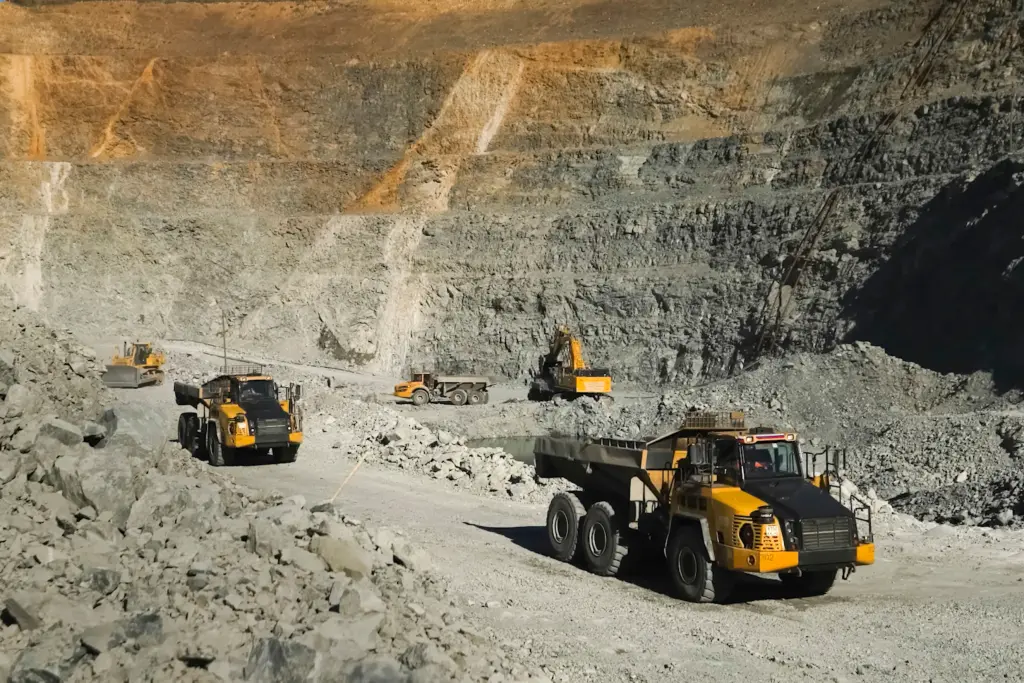
In a gold mine, a Level 9 CAS typically protects the full spread of the fleet: ultra-class haul trucks, articulated dump trucks, hydraulic excavators, rope shovels, wheel loaders, dozers, graders, water trucks, fuel trucks, service and light vehicles, buses, and pedestrians wearing electronic tags.
Its value concentrates in the highest-risk zones of the pit — haul-road intersections, blind corners, pit ramps, loading and dumping areas, crusher approaches, workshops, fuel stations, the ROM pad, and shift-change parking areas — where paths cross unpredictably and visibility is often compromised.
Key features
A mature Level 9 platform generally provides 360° situational awareness, predictive collision algorithms, and dynamic safety zones that expand and contract with vehicle speed, backed by automatic emergency braking and machine intervention. Around that core sit the operational tools: operator alerts, event recording and playback, black-box incident recording, fleet monitoring, health diagnostics, real-time reporting dashboards, and integration with fleet management systems.
Why it matters
The benefits of a well-implemented Level 9 system extend well beyond safety statistics. Operations report reduced fatalities and serious injuries, lower equipment damage, and reduced downtime alongside improved operator awareness and better traffic management. Those gains flow through to lower insurance and accident costs and increased productivity from running a safer, more predictable operation, all while supporting compliance with mining safety requirements.
Standards and guidance
A credible Level 9 implementation aligns with established frameworks rather than proprietary claims alone. The most relevant are the EMESRT Vehicle Interaction Controls framework, ISO 21815 for collision warning and avoidance systems on earth-moving machinery, and national mining safety regulations — in South Africa, the Minerals Council Collision Prevention System framework where applicable.
A worked scenario
Consider a 220-tonne haul truck descending a ramp as a light vehicle approaches a blind intersection. Both vehicles continuously transmit their position, speed, and heading. The CAS predicts that their paths will intersect within a few seconds and issues visual and audible warnings to both operators. If neither operator reacts, the Level 9 controller automatically reduces the haul truck’s speed. If the collision risk remains, the system applies the brakes and brings the truck to a controlled stop before the intersection — preventing a collision that human reaction time alone might not have averted.
Choosing and verifying a Level 9 system
Because “Level 9” describes a capability rather than a certification anyone can self-award, independent verification matters. A genuine Level 9 provider — such as Mine Safe Global Level 9, built for mixed-OEM and legacy fleets — should be able to demonstrate every point below on request. When evaluating providers, ask them to show:
- Genuine automatic braking and throttle intervention, not warnings relabelled as intervention
- Compliance with EMESRT and ISO 21815
- Independent validation, such as University of Pretoria TRL4 verification where applicable
- Compatibility with mixed OEM fleets (Caterpillar, Komatsu, Hitachi, Liebherr, Bell)
- Integration with your fleet management system (Modular, MineStar, DISPATCH)
- Reliable pedestrian and light-vehicle protection
- Consistent performance in dust, rain, and poor visibility
- Local installation, maintenance, and training support
- Proven deployments at comparable open-pit mines
How Mine Safe Global delivers Level 9
Mine Safe Global Level 9 is engineered for exactly the conditions above — the mixed-OEM, mixed-generation fleets that most open-pit gold mines actually run, rather than a single manufacturer’s equipment. The system pairs true automatic intervention (throttle, transmission, and braking control) with retrofit capability, so haul trucks, light vehicles, and legacy machines can be brought under one collision-avoidance regime without wholesale fleet replacement.
That means the evaluation checklist above is not a hurdle to clear but a starting specification: automatic braking and throttle intervention, alignment with EMESRT and ISO 21815, mixed-OEM compatibility across Caterpillar, Komatsu, Hitachi, Liebherr, and Bell, integration with fleet management platforms, and pedestrian and light-vehicle protection that holds up in dust, rain, and poor visibility. If you are scoping a Level 9 deployment for an open-pit operation, talk to Mine Safe Global about matching the system to your fleet, your high-risk zones, and your compliance obligations.
The bottom line
Level 9 is the most advanced operational level in the EMESRT framework because it goes beyond warning the operator — it actively intervenes in vehicle control when a collision is imminent. For an open-pit gold mine running mixed fleets across intersecting haul roads, ramps, and loading areas, that intervention capability represents the highest level of protection currently defined for surface mining operations — and it is the standard Mine Safe Global Level 9 is built to meet.
Frequently asked questions
What is CAS Level 9?
CAS Level 9 is the highest level of machine intervention in the EMESRT vehicle interaction controls framework. Unlike lower levels that only warn or advise an operator, a Level 9 collision avoidance system can take direct control of a mining vehicle — automatically reducing speed or applying the brakes — when the operator does not respond to an imminent collision hazard.
What is the difference between EMESRT Level 8 and Level 9?
Level 8 provides an advisory intervention: the system warns the operator and may recommend corrective action, but the operator remains in full control of the machine. Level 9 goes further by taking automatic control of the vehicle — intervening in throttle, transmission, or braking — when a collision is imminent and the operator fails to react. Level 9 is the highest level currently defined in the EMESRT framework.
Is Level 9 collision avoidance required in South African mines?
South African mining operations are governed by the Mine Health and Safety Act and the Minerals Council Collision Prevention System framework, which drive the adoption of collision avoidance systems capable of machine intervention. Requirements depend on the operation and its risk assessment, so mines should confirm their specific obligations against current regulations and their own trigger action response plans.
Can a Level 9 collision avoidance system be retrofitted to a mixed fleet?
Yes. A Level 9 system designed for retrofit can be installed across mixed-OEM and legacy fleets — including Caterpillar, Komatsu, Hitachi, Liebherr, and Bell equipment — bringing haul trucks, light vehicles, and older machines under a single collision avoidance regime without wholesale fleet replacement. Mine Safe Global Level 9 is built specifically for these mixed-OEM and legacy fleet conditions.