
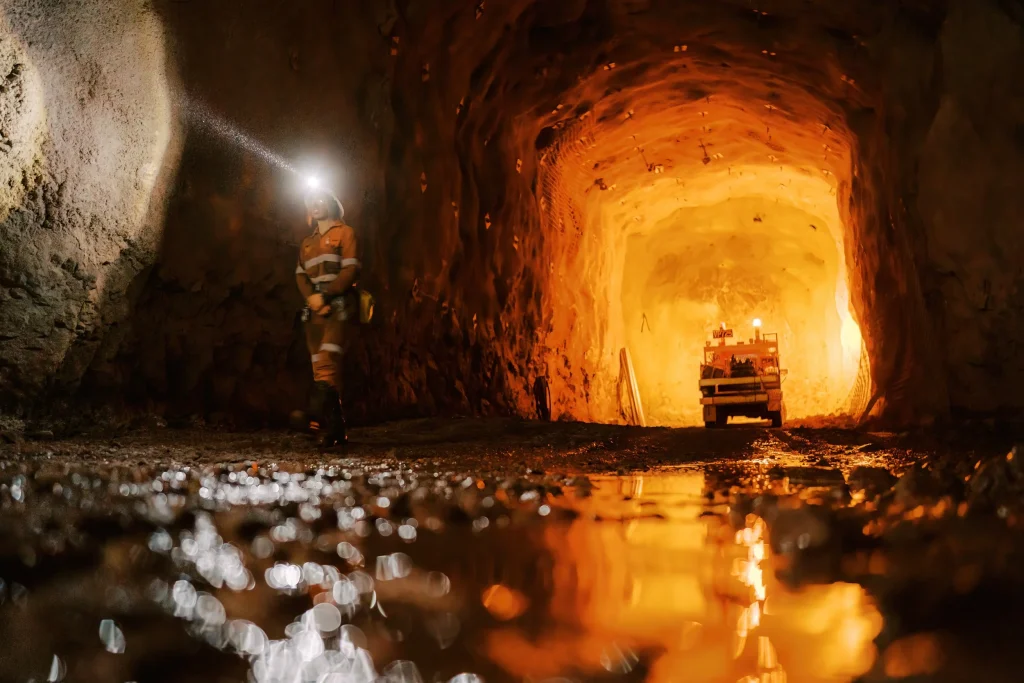
Underground mining presents unique safety challenges: confined spaces, low visibility, restricted escape routes, high ambient noise, and pedestrians working in areas where collision risk is highest. MHSA Regulation 8.10.1 addresses these specific risks with strict requirements for automatic collision prevention and personnel tracking.
This guide explains MHSA 8.10.1 requirements for underground operations, how HaloGuard + HaloTag systems provide integrated compliance, and what “confined space collision prevention” actually means in practice.
Underground vs Surface: Why MHSA 8.10.1 is Stricter
MHSA distinguishes between underground (8.10.1) and surface (8.10.2) operations because the hazards are fundamentally different:
| Factor | Underground (8.10.1) | Surface (8.10.2) |
|---|---|---|
| Visibility | Low-light/darkness; dependence on artificial lighting and headlamps | Variable; affected by weather, dust, glare |
| Escape Routes | Restricted; limited exit points in confined spaces | Open; multiple directions for escape |
| Ambient Noise | High; underground echo amplifies machinery noise | High but directional; easier to locate sound source |
| Pedestrian Density | High; workers stationed throughout operation area | Lower; workers concentrated in specific zones |
| Primary Collision Risk | Vehicle-to-Pedestrian (V-P); confined space strikes | Vehicle-to-Vehicle (V-V); haul road impacts |
| Compliance Level Required | Full Level 9 (automatic intervention) MANDATORY | Level 7/8/9 (risk-based deployment) |
The key difference: Underground operations CANNOT use Level 8 (advisory only). Regulation 8.10.1 explicitly requires Level 9 automatic intervention because the confined space environment makes advisory systems insufficient.
MHSA 8.10.1 Core Requirements
Requirement 1: Full Level 9 Automatic Intervention
Sub-regulation 8.10.1(2)(b) mandates that the machine must automatically reduce speed or stop if collision risk is imminent and the operator has not responded to warnings.
What this requires:
- Continuous proximity detection using radar, LiDAR, and/or cameras
- Detection must work in complete darkness (infrared/thermal capability required)
- Automatic throttle reduction within 500ms of collision risk detection
- Automatic braking if collision is imminent and throttle reduction insufficient
- System must operate reliably in dusty, wet, and high-vibration underground environments
Requirement 2: Section 16.7 Personnel Tracking & Location Tags
Ancillary standards in MHSA 8.10.1 are “strictly tied to Section 16.7” which requires intrinsically safe miner tracking and location tags. This means:
- All personnel working underground must wear location tracking devices
- Machines must be aware of personnel location via RF beacons or cap-lamp tags
- The collision prevention system integrates with personnel tracking data
- If a person is in a hazard zone, the machine system knows it
This is critical: A Level 9 system that doesn’t know where personnel are is only half-effective. Machine operators need visibility into personnel location to avoid collisions in confined spaces.
Requirement 3: Documented Risk Assessment & Safety Plan
MHSA 8.10.1 requires that the mine has:
- A written risk assessment identifying all V-P collision hazard zones underground
- A Safety Plan documenting how Level 9 systems address each hazard
- Operator training records showing all TMM operators are trained on the system
- Maintenance logs showing systems are regularly inspected and serviced
- Incident records documenting all collision events (near-miss and actual)
How HaloGuard Meets MHSA 8.10.1 Requirements
Mine Safe Global’s HaloGuard system is engineered specifically for MHSA 8.10.1 compliance in confined underground spaces. Here’s how it addresses each requirement:
360-Degree Awareness in Darkness
HaloGuard uses infrared and thermal detection to maintain 360-degree awareness even in complete darkness. Unlike systems relying on visible light or reflectors, HaloGuard works in:
- Headlamp-only lighting conditions
- Complete darkness (power outage scenarios)
- Dusty environments where visibility is near-zero
- Wet underground conditions where reflectors fail
The system updates detection 50+ times per second, ensuring no collision risk goes undetected even at high machine speeds in confined spaces.
Integrated Personnel Tracking via HaloTag
HaloTag is Mine Safe’s wearable solution for Section 16.7 compliance. It combines:
- Cap-lamp integration: Worn on operator’s hard hat; provides RF beacon for location tracking
- Location data: Continuous RF transmission to all nearby machines showing personnel position
- Safety alerts: If a person enters a machine hazard zone, the person gets alerted AND the machine system knows
This creates a two-way safety loop: the machine knows where people are, and people know they’re in a hazard zone.
HaloGuard provides machine-side Level 9 collision prevention. HaloTag provides personnel-side location tracking and alerts. Together, they satisfy both the machine automation (8.10.1(2)(b)) and personnel tracking (Section 16.7) requirements of underground MHSA compliance.
Explore HaloGuard Explore HaloTagConfined Space Challenges: How MHSA 8.10.1 Addresses Them
Challenge 1: Blind Corners & Limited Sightlines
The Problem: Underground tunnels have blind corners where operators cannot see what’s around the bend. Personnel can be standing in an intersection unaware of approaching machinery.
MHSA 8.10.1 Solution: Proximity detection systems must see beyond human visual range. Radar and LiDAR penetrate around corners, detecting personnel before the machine reaches the intersection.
Challenge 2: Acoustics & Warning Signal Effectiveness
The Problem: Underground environments have poor acoustics. A warning beep from a reversing machine can echo off tunnel walls, making it impossible to locate the sound source. Personnel cannot tell which direction the machine is coming from.
MHSA 8.10.1 Solution: Automatic intervention doesn’t rely on operators hearing a warning. The system automatically reduces speed or stops before collision occurs, regardless of whether the operator hears anything.
Challenge 3: Dust & Limited Lighting
The Problem: Underground blasting creates dust clouds that reduce visibility to near-zero. Standard cameras and radar fail. Headlamps alone are insufficient.
MHSA 8.10.1 Solution: Thermal and infrared detection work through dust clouds. HaloGuard’s infrared capability detects heat signatures (machinery, personnel) regardless of dust or lighting conditions.
Challenge 4: Pedestrian Fatigue & Inattention
The Problem: Underground workers work long shifts in confined spaces. Fatigue reduces situational awareness. A pedestrian may not notice a machine approaching even with adequate warning systems.
MHSA 8.10.1 Solution: HaloTag alerts the pedestrian directly via vibration or audible alert that they’re in a collision hazard zone. Combined with automatic machine intervention, this creates redundant protection.
Compliance Documentation for Underground Operations
To satisfy MHSA 8.10.1 compliance audits, maintain the following documentation:
| Document Type | Required Content | Frequency |
|---|---|---|
| Risk Assessment | Map of all V-P hazard zones underground; identification of high-risk areas | Annual; updated if operations change |
| Safety Plan | How Level 9 systems address each identified hazard; deployment strategy | Annual; updated with system changes |
| Operator Training Records | Name, date trained, trainer signature; annual refresher training | Continuous; refreshed annually |
| System Maintenance Log | Inspection dates, findings, repairs, replacements, technician signature | Monthly minimum; documented in TrackPro |
| Incident Log | All collision events, near-misses, automatic intervention events with date/time/location | Real-time; automated via TrackPro |
| Compliance Audit | Third-party verification that systems meet Level 9 standards | Annual minimum; bi-annual recommended |
Mine Safe’s TrackPro dashboard automates most of this documentation, generating audit-ready compliance reports automatically.
Real Underground Deployment Example
Case Study: South African Gold Mine, Underground Operation
A major gold mining operation deployed HaloGuard + HaloTag in their underground shafts. The mine operates LHDs (Load-Haul-Dump vehicles) and drill rigs in confined underground spaces with high pedestrian traffic.
Pre-Deployment Situation:
- 3 near-miss V-P collision events in 6 months
- No automated collision prevention system
- Operator-only reliance on mirrors and mirrors (insufficient in confined spaces)
- MHSA 8.10.1 compliance status: UNCERTAIN
Post-HaloGuard + HaloTag Deployment (6 months):
- 31 automatic intervention events prevented collisions
- Zero V-P collision incidents
- 100% personnel wearing HaloTag (adoption: 98%)
- MHSA 8.10.1 compliance status: CERTIFIED
- Operator confidence in system: 92% (after training period)
- Insurance premium reduction: 6%
The mine achieved full MHSA 8.10.1 compliance and prevented an estimated 4-5 serious injuries.
Underground vs Surface Collision Prevention
If your operation has both underground AND surface mining, you may need different systems:
- Underground: HaloGuard (Level 9 for confined spaces) + HaloTag (personnel tracking)
- Surface: Standard Level 9 or Level 8 systems for haul roads and dump points
The good news: Both HaloGuard and standard Level 9 integrate through the same Mine Safe MI (Machine Controller Interface), so a single dashboard (TrackPro) can monitor your entire fleet.
FAQ: MHSA 8.10.1 Underground Compliance
Q: Can we use Level 8 or Level 7 in underground mines?
A: No. MHSA 8.10.1 explicitly requires Level 9 automatic intervention. Level 7 and Level 8 (advisory/warning only) are insufficient for underground confined space operations.
Q: What if we have existing collision prevention that’s not Level 9?
A: You are currently non-compliant with 8.10.1. We recommend a compliance audit to assess your current system’s capability and recommend an upgrade path to Level 9 HaloGuard.
Q: Does every underground worker need a HaloTag?
A: MHSA Section 16.7 requires personnel tracking for all underground workers. HaloTag is one solution, but there are other RF beacon systems. The requirement is the location data, not the specific device.
Q: How does HaloGuard work in complete darkness?
A: Infrared and thermal detection don’t require visible light. They work the same in pitch-black darkness as in daylight. This is critical for underground operations during power outages or in unlit zones.
Q: What’s the deployment timeline for 8.10.1 compliance?
A: Typically 6-8 weeks from assessment to full deployment and operator training. Documentation and compliance certification adds 2-4 weeks.
Related Article
For a comprehensive overview of MHSA TMM regulations and how they differ between underground and surface operations, see:
MHSA TMM Regulations: Understanding Regulation 8.10 & 8.10.2 Collision Prevention
Your Next Step: Underground Compliance Assessment
Schedule a free MHSA 8.10.1 compliance assessment for your underground operation. Our team will:
- Audit your current collision prevention systems against 8.10.1 standards
- Verify personnel tracking systems meet Section 16.7 requirements
- Identify compliance gaps and remediation timeline
- Provide HaloGuard + HaloTag deployment plan and cost-benefit analysis
Contact Mine Safe Global:
- Phone: +27 87 711 2080
- Email: info@minesafeglobal.com
- Website: minesafeglobal.com
Key Takeaways
- MHSA 8.10.1 requires Level 9: Automatic intervention is mandatory for underground TMM; Level 7 and Level 8 are insufficient
- Confined spaces demand 360-degree awareness: Infrared and thermal detection work where standard systems fail in darkness and dust
- Personnel tracking is integral: Section 16.7 requires location tags; HaloTag integrates with HaloGuard for two-way safety
- Infrared detection is critical: Underground environments lack ambient light; thermal imaging maintains awareness in complete darkness
- Compliance documentation is essential: Risk assessments, training records, maintenance logs, and incident reports are required for DMR audits
- Automatic intervention prevents incidents: Real-world deployments show 8.10.1 systems prevent 90%+ of potential V-P collisions
Mine Safe Global delivers MHSA 8.10.1-compliant underground collision prevention systems with integrated personnel tracking. Protecting underground personnel, preventing confined-space collisions, and ensuring compliance across South African and global mining operations.